
Mobile Number Revocation: Regulations and Fraud Prevention
Understand MNRL, mobile number revocation rules in India, and how revocation checks help businesses identify risks and strengthen customer verification.
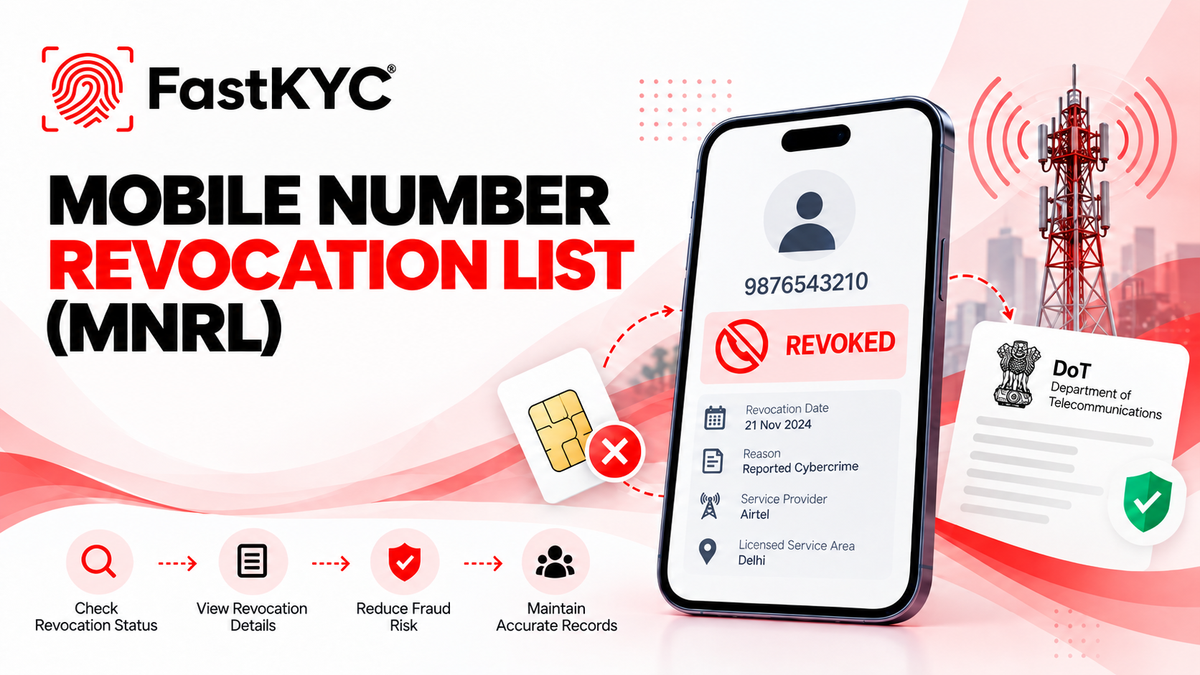
Mobile numbers are widely used for customer verification, OTP authentication, account recovery and financial transactions. However, when a number is disconnected or revoked, it may eventually be reassigned to another subscriber. Businesses that continue using outdated mobile numbers risk communication failures, privacy issues and potential account misuse.
The Mobile Number Revocation List (MNRL) helps businesses identify numbers recorded as revoked and determine whether customer records require further verification.
What Is MNRL?
The Mobile Number Revocation List (MNRL) contains mobile numbers disconnected for various reasons, including failed re-verification, reported cybercrime, suspected misuse and prolonged inactivity.
The Department of Telecommunications (DoT) makes MNRL available through its Digital Intelligence Platform (DIP), allowing relevant stakeholders to access revocation information.
Checking this information helps businesses identify mobile numbers that may no longer be suitable for their existing customer records.
Why Is Mobile Number Revocation Important?
A customer may discontinue a mobile connection without updating their bank, lending platform or other service provider. If the number is later reassigned, another subscriber could receive messages intended for the previous user.
This creates risks involving account recovery, sensitive notifications and customer-data accuracy.
MNRL checks help businesses identify potentially revoked numbers, prioritise records for review and decide when additional verification is necessary. They provide an additional risk signal rather than definitive proof of fraud or current number ownership.
MNRL Regulations: What Businesses Need to Know
TRAI's order dated 21 November 2024 discontinued publication of MNRL through its own portal after January 2025 because DoT had made the list available to stakeholders through DIP on a near-real-time basis. The TRAI portal subsequently remained available for archival access until 30 June 2025.
For regulated entities, TRAI-published guidance highlights three practical measures:
- Clean customer databases: Use MNRL to identify customer records associated with revoked numbers.
- Verify updated contact details: Follow appropriate verification procedures before changing a customer's registered mobile number.
- Monitor linked accounts: Apply enhanced monitoring to accounts associated with revoked numbers to help identify potential money-mule activity and cyber fraud.
These measures are particularly relevant to financial institutions that rely on mobile numbers for account access and transaction communications. Businesses should establish procedures appropriate to their applicable regulatory requirements. A revoked-number match should trigger suitable review, not automatic rejection of a customer.
Where Is MNRL Check Used?
MNRL checking can support several business workflows:
- Banking and financial services: Identify customer records linked to revoked mobile numbers for further review.
- Digital lending and insurance: Review customer contact details and flag revoked numbers for verification.
- Customer onboarding: Check mobile number revocation status as part of customer verification.
- Account recovery and OTP workflows: Use revocation information as an additional risk signal alongside existing authentication controls.
- Customer database maintenance: Identify records associated with revoked numbers and review contact details for updates.
MNRL Check vs Mobile Number Verification
MNRL checking identifies whether available records mark a number as revoked. Mobile number verification, including OTP-based verification, helps establish access to a number or verify information through the applicable process.
These checks serve different purposes. An OTP confirms access to a number at the time of verification, but does not independently establish legal identity. Similarly, an MNRL result does not establish who currently owns a number.
Businesses can combine both checks with appropriate identity verification and risk controls.
What Information does the MNRL Check API Return?
The MNRL Check API returns available mobile number revocation details, which may include:
- Mobile number status and revocation indicator.
- Revocation date and reason, when available.
- Action taken after revocation, if provided.
- Telecom service provider and licensed service area.
- Additional fraud-risk indicator details, where available.
Integrate MNRL Checks Through an API
For businesses that need to check mobile number revocation status at scale, API integration makes the process easier to automate.
Submit the mobile number in the API request to retrieve its available revocation status and related details. You can integrate this check into customer onboarding, contact database management and fraud-risk assessment workflows.