
SEBI Records Verification: Debarment, Revocation and Compliance Checks
SEBI records verification helps businesses check debarment orders, revocation history and regulatory records for compliance screening.
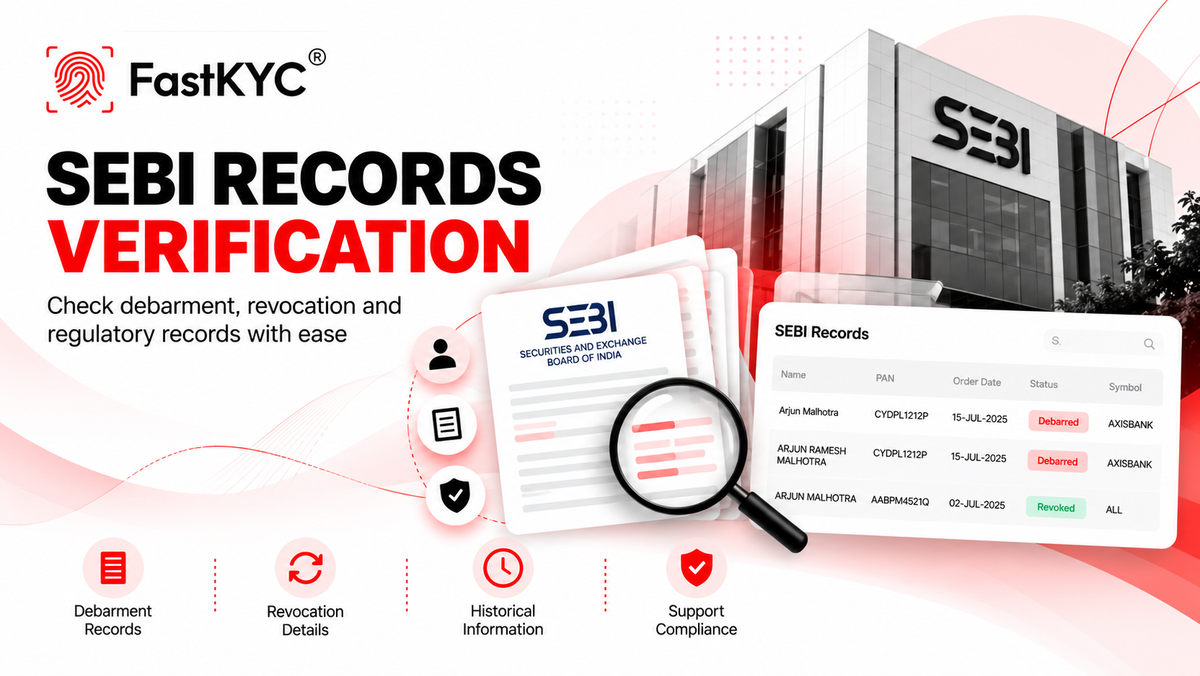
Financial institutions, brokerage firms and compliance teams often need to check whether an individual or entity appears in regulatory records before proceeding with certain business activities. Reviewing these records manually can take time, especially when information is spread across regulatory orders, stock exchange circulars and historical documents.
SEBI Records Verification helps businesses retrieve relevant records of regulatory actions including debarment details, order information and revocation history in a structured format. This makes it easier to review the available information and support compliance processes.
1. What Is SEBI Records Verification?
SEBI Records Verification involves checking records related to regulatory directions and actions issued by the Securities and Exchange Board of India (SEBI) and published through official sources.
SEBI is India’s securities market regulator. It works to protect investors, regulate the securities market and promote fair market practices.
Regulatory records may contain information about individuals or entities subject to orders or directions, including restrictions on participating in securities market activities.
Verification can help businesses identify relevant records and review details such as:
- Individual or entity name
- Permanent Account Number (PAN), where available
- Order date and order particulars
- Debarment date and applicable period
- Revocation date, where available
- Related stock exchange circulars
- Associated security symbol, where applicable
These details help compliance teams understand the records returned for a particular search. A matching record should always be interpreted in the context of the underlying order and its current status.
2. What Is SEBI Debarment?
SEBI debarment refers to restrictions imposed through regulatory orders or directions that prevent an individual or entity from undertaking specified activities in the securities market.
The nature and duration of the restriction depend on the applicable order. For example, an order may restrict access to the securities market for a specified period or until further directions.
A debarment record may contain:
- The name of the individual or entity
- The date of the relevant order
- The reason or matter associated with the order
- The applicable debarment period
- A reference to the official order or exchange circular
These details provide a starting point for determining whether further investigation is required.The presence of a record does not, by itself, establish that a restriction is still active. The applicable order, subsequent directions and any revocation information must be reviewed.
3. What Is SEBI Debarment Revocation?
Revocation refers to the withdrawal or cancellation of a previously imposed restriction, as specified in a later regulatory order or direction.
A record may include both the original debarment details and a subsequent revocation date. Reviewing both is important because the original order alone may not reflect the latest recorded status.
For example, a record may show:
- An original order date
- The date a debarment was recorded
- A subsequent revocation date
- A reference to the circular associated with the revocation
If a revocation date is available, it should be reviewed alongside the original order and the revocation document. If the field is empty or null, that should not automatically be interpreted as proof that the restriction remains active; the latest official records should be checked.
4. Why Is Historical SEBI Record Verification Important?
Checking only the latest available record may not provide the complete history of regulatory actions associated with an individual or entity.
Historical verification helps businesses review earlier orders, subsequent revocations and changes reflected in the available records. For example, a search may return an earlier debarment record together with a later record referencing revocation. Reviewing the history helps the compliance team understand the sequence of recorded events.
Historical information is particularly useful when:
- Reviewing past regulatory actions
- Investigating records associated with a PAN
- Checking whether a revocation reference is available
- Comparing records published under different name variations
- Reviewing the background of an existing or prospective business relationship
Historical records should not be treated as a definitive statement of current status without checking the latest applicable orders and official publications.
5. How Does SEBI Records Verification Work with FastKYC?
The feature accepts a PAN and a history parameter and returns a structured response containing available SEBI-related records.
Step 1: Submit the search details
The request includes the sebi-records feature and the PAN to be checked. The history parameter can be included when requesting historical records.
Step 2: Retrieve the matching records
The response contains a sebi_record array, which can include one or more records associated with the search.
Step 3: Review the record details
Each returned record may include the name, PAN, order particulars, dates, applicable period and links to relevant circulars.
Step 4: Review debarment and revocation information
The available debarment and revocation fields help the reviewer understand the recorded sequence of regulatory actions. The underlying circulars should be consulted when determining the implications of a record.
Step 5: Use the results in compliance workflows
Businesses can use the structured response to support their internal review processes, recordkeeping and escalation procedures. Any final decision should follow the organisation’s compliance policy and the applicable regulatory requirements.
6. How Can Businesses Use SEBI Records Verification?
- Compliance screening – Use returned records as an input to screening processes and determine whether additional investigation is necessary.
- Financial services onboarding – Incorporate regulatory record checks into onboarding procedures where relevant to business activities and legal obligations.
- Brokerage and securities-related workflows – Review relevant orders and restrictions before proceeding with activities that require regulatory checks.
- Historical record review – Examine available historical records to understand previous regulatory actions and identify references to subsequent revocations.
- Compliance recordkeeping – Maintain consistent internal records of checks performed, subject to appropriate access controls, retention policies and data protection requirements.
SEBI records verification should support a broader compliance process rather than act as the sole basis for every business decision.
7. Best Practices for SEBI Records Verification
To use SEBI records responsibly and accurately, businesses should follow a consistent verification process:
- Use accurate identifiers – Submit the correct PAN and review other identifying information available in the returned record.
- Review name variations – Similar or differently formatted names may appear across multiple records. Do not assume every result represents a separate individual or regulatory matter.
- Check the original order – Use the linked circular or order to understand the restriction and its scope.
- Review revocation information – Check whether a later order or circular modifies or withdraws an earlier restriction.
- Validate current status – Consult the latest available official records before reaching a conclusion about whether a restriction remains effective.
- Handle missing fields carefully – An empty or null field means the information is not populated in that response; it does not automatically establish a particular regulatory status.
- Protect personal information – Restrict access to PAN and other identifying information and process it only for an authorised purpose.
- Document the review – Maintain appropriate records of the source, review date and conclusions in accordance with internal compliance procedures.
These practices help reduce the risk of misinterpreting historical records, duplicate entries or incomplete information.
- SEBI Compliance
- Debarment Records
- Revocation History
- Securities Market