
CKYCRR 2.0 Explained: What’s Changing in Central KYC
CKYCRR 2.0 is the upgraded Central KYC system with real-time APIs, OTP consent and mandatory Aadhaar masking.
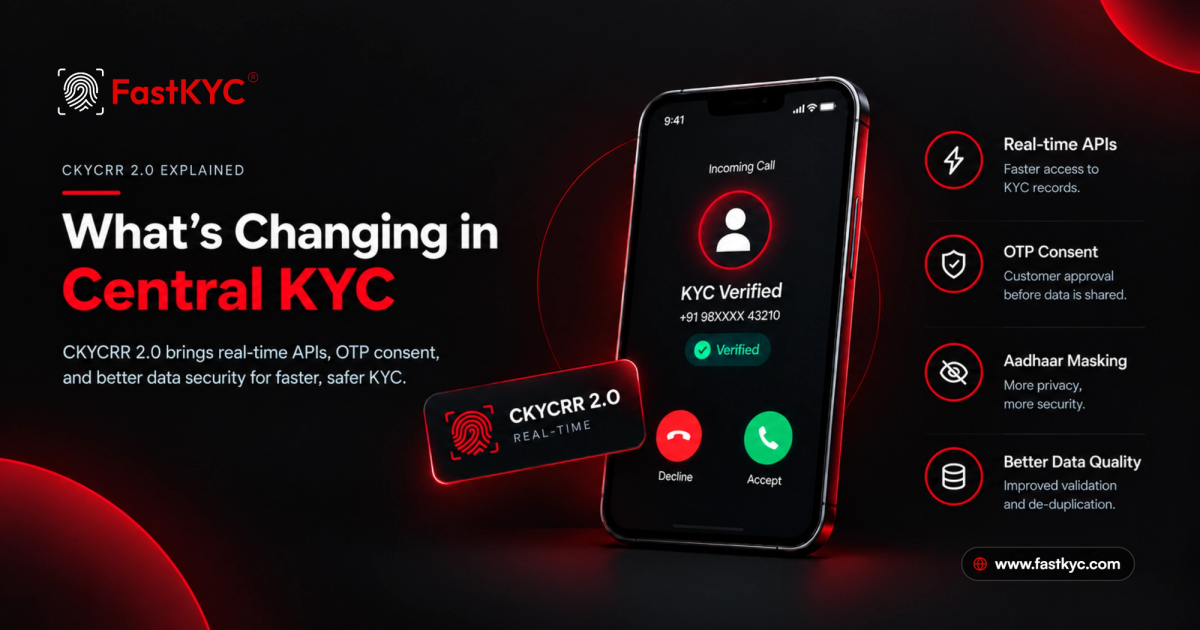
CKYCRR 2.0 is the upgraded version of India’s Central KYC Records Registry. It moves the system from batch uploads and static documents to real-time, API-based KYC record sharing.
For banks, NBFCs, insurers and fintechs, this changes how customer KYC data is uploaded, searched, downloaded and updated.
What is CKYCRR?
CKYCRR stands for Central KYC Records Registry. It is operated by CERSAI and acts as a central database of customer KYC records across RBI, SEBI, IRDAI and PFRDA regulated entities.
The idea is simple: a customer completes KYC once, the record is uploaded to the registry, and other regulated entities can later retrieve it instead of collecting the same documents again.
What is CKYCRR 2.0?
CKYCRR 2.0 is a major upgrade of the earlier CKYC system (often called CKYC 1.0).
Key shifts include:
- Move from batch file uploads to real-time APIs
- Structured JSON/XML data instead of PDF-heavy submissions
- Mandatory OTP-based customer consent before data is shared
- Compulsory Aadhaar masking
- Better de-duplication and data quality controls
Pilot testing for CKYCRR 2.0 concluded in early October 2026. CKYCRR 1.0 services continue to operate until further instructions from CERSAI.
Key Changes in CKYCRR 2.0
1. Real-time APIs instead of batch uploads
Earlier, institutions uploaded records in bulk (often PDFs or spreadsheets).
In 2.0, search, download, upload and update happen through structured APIs with faster validation.
2. Explicit OTP consent
Before a regulated entity can download or reuse an existing CKYC record, an OTP is sent to the customer’s registered mobile number. The customer must authenticate the OTP before data is released.
3. Mandatory Aadhaar masking
The first eight digits of the Aadhaar number must be masked before a record is submitted or shared.
4. Better data quality and de-duplication
The upgraded system places stronger emphasis on structured data, validation rules and reducing duplicate records.
Why CKYCRR 2.0 Matters for Lenders and Fintechs
- Faster reuse of existing KYC records
- Stronger consent and audit trail
- Alignment with DPDP Act principles
- Reduced need to collect the same documents repeatedly
- Cleaner onboarding journeys when the customer already has a KYC Identifier
How the Flow Typically Works
- Customer provides KYC Identifier or basic identifiers (PAN, mobile, etc.)
- Regulated entity searches the registry
- Customer receives an OTP for consent
- After successful OTP authentication, the record can be downloaded
- Institution uses the verified data for onboarding or updates
Important Points for Reporting Entities
- Complete testbed and onboarding activities as directed by CERSAI
- Update internal systems to support the new API and data formats
- Build proper OTP consent capture and logging
- Ensure Aadhaar masking is applied consistently
- Continue using CKYCRR 1.0 for live transactions until official migration instructions are issued
- CKYCRR 2.0
- CKYC
- Central KYC
- CERSAI
- KYC Identifier