

FastKYC

What is Face Match in Digital KYC? A Complete Guide

Face Match in KYC explained: learn how selfie-to-ID comparison works, why it matters for lenders, and how it strengthens digital verification.

Krithick TSoftware Engineer
Face-Match
On this page 5 sections

What is Face Match?

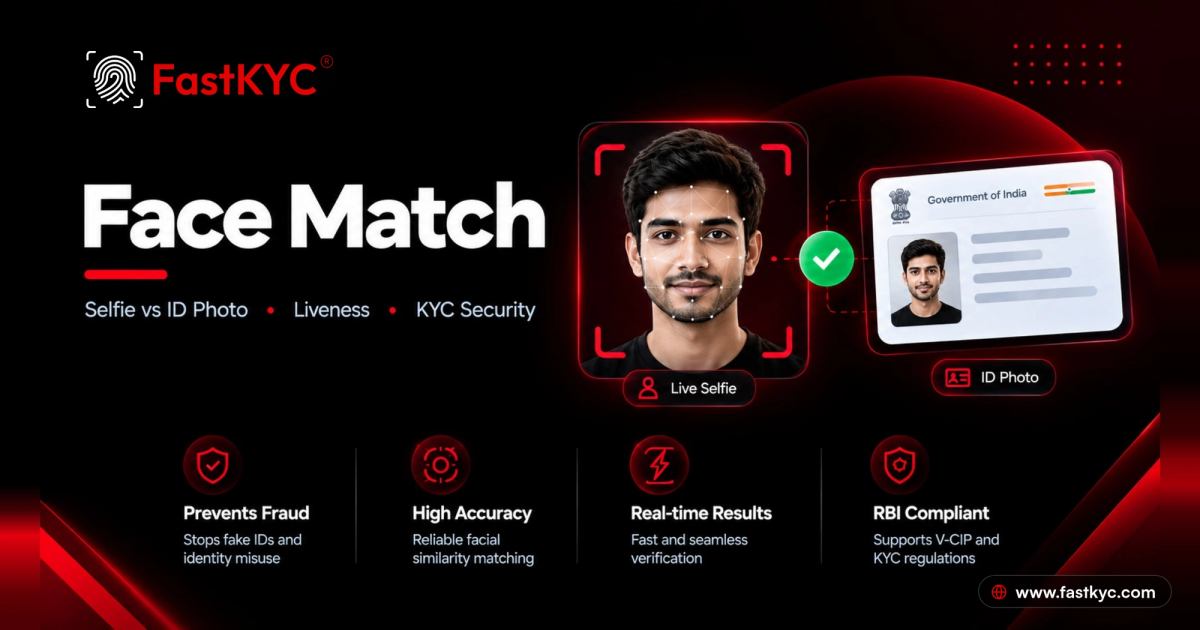
Face Match (also called face verification or 1:1 face comparison) is a technology that compares two facial images and returns a similarity score.

In KYC, the two images are usually:

  • A reference photo extracted from an identity document
  • A live selfie captured during the onboarding process

If the similarity score crosses a set threshold, the system treats it as a match.

How Face Match Works

The process typically follows these steps:

  1. The user uploads or captures an identity document.
  2. The system extracts the face photo from the document (often using OCR).
  3. The user takes a live selfie (sometimes with liveness checks).
  4. The Face Match engine converts both faces into numerical templates.
  5. It calculates a similarity score between the two templates.
  6. The score is compared against a threshold to decide match or no-match.

Modern systems are designed to handle variations in lighting, angle, age, and image quality while keeping false match rates very low.

Why Face Match Matters for Lenders and Fintechs

  • Reduces identity fraud during onboarding
  • Helps meet RBI expectations for remote verification
  • Strengthens Video KYC (V-CIP) flows
  • Improves trust in self-served digital journeys
  • Works well with Aadhaar, PAN, Passport and other OVDs

RBI’s KYC Master Directions require face matching technology with a high degree of accuracy in Video-based Customer Identification Process (V-CIP), along with liveness/spoof detection.

Common Use Cases

  • Customer onboarding for loans, credit cards and bank accounts
  • Video KYC / V-CIP sessions
  • Re-KYC and account recovery
  • Employee verification
  • High-risk or high-value account opening

How Face Match Fits into a Full KYC Stack

A robust digital onboarding flow usually combines:

  1. Document verification (OCR + authenticity checks)
  2. Face Match (selfie vs ID photo)
  3. Liveness detection
  4. Other checks (PAN, Aadhaar, bank account, credit report, etc.)

At FastKYC, Face Match can be used together with Aadhaar verification, PAN checks, liveness detection and other APIs for a complete identity verification layer.

  • Face Match
  • Liveness Detection
  • Digital KYC
  • Biometric Verification
  • Video KYC

Frequently Asked Questions (FAQs)

What is Face Match in KYC?

Face Match is a biometric check that compares a live selfie with the photograph on a government ID to confirm they belong to the same person.

How accurate is Face Match technology?

Modern Face Match systems used in regulated KYC achieve very low false match rates (often below 0.01–0.05% in controlled conditions) while keeping false rejection rates manageable for real-world use.

Is Face Match mandatory under RBI guidelines?

RBI’s KYC Master Directions require face matching technology with a high degree of accuracy as part of V-CIP (Video KYC). It is a key component of compliant remote onboarding.

What is the difference between Face Match and Face Recognition?

Face Match is a 1:1 comparison (selfie vs one ID photo). Face Recognition is usually a 1:N search against a database of many faces.

Does Face Match work with poor quality photos?

Performance depends on image quality. Systems are trained to handle moderate variations in lighting, angle and resolution, but very blurry or low-resolution images can lower the similarity score.

Can Face Match detect deepfakes?

Face Match itself compares facial features. Deepfake protection mainly comes from strong liveness detection (active or passive) that runs alongside Face Match.

What documents can be used for Face Match?

Commonly used documents include Aadhaar, PAN card, Passport, Driving Licence and Voter ID — any official photo ID from which a clear face can be extracted.

How long does a Face Match check take?

Most API-based Face Match solutions return results in under a second, making them suitable for real-time onboarding flows.

Do users need to perform specific gestures for Face Match?

Not for the Face Match comparison itself. Gestures (blink, head turn, etc.) are typically part of the separate liveness check.

Can Face Match be automated through an API?

Yes. Businesses can integrate a Face Match API to automatically compare the selfie and ID photo during onboarding, lending or account opening journeys.

Previous articles

All articles

Ready to integrate?

Talk to our team and we will map the checks your flow actually needs.

  • One API key for every check
  • Verified against official Indian records
  • Built for onboarding at scale
FastKYC

Book a demo

See FastKYC on the checks you run

KYC, KYB, Verification APIs, OCR, SMS, WhatsApp & Custom solutions

Tell us what you need to verify and we will get back to you.

APIs
170+
Verifications
1.2M+
Checks a day
5000+