

FastKYC

Liveness Detection in KYC: How It Stops Deepfakes

Learn what liveness detection is in digital KYC, how it prevents photo, video and deepfake spoofing

Krithick TSoftware Engineer
face-liveness
On this page 6 sections

What is Liveness Detection?

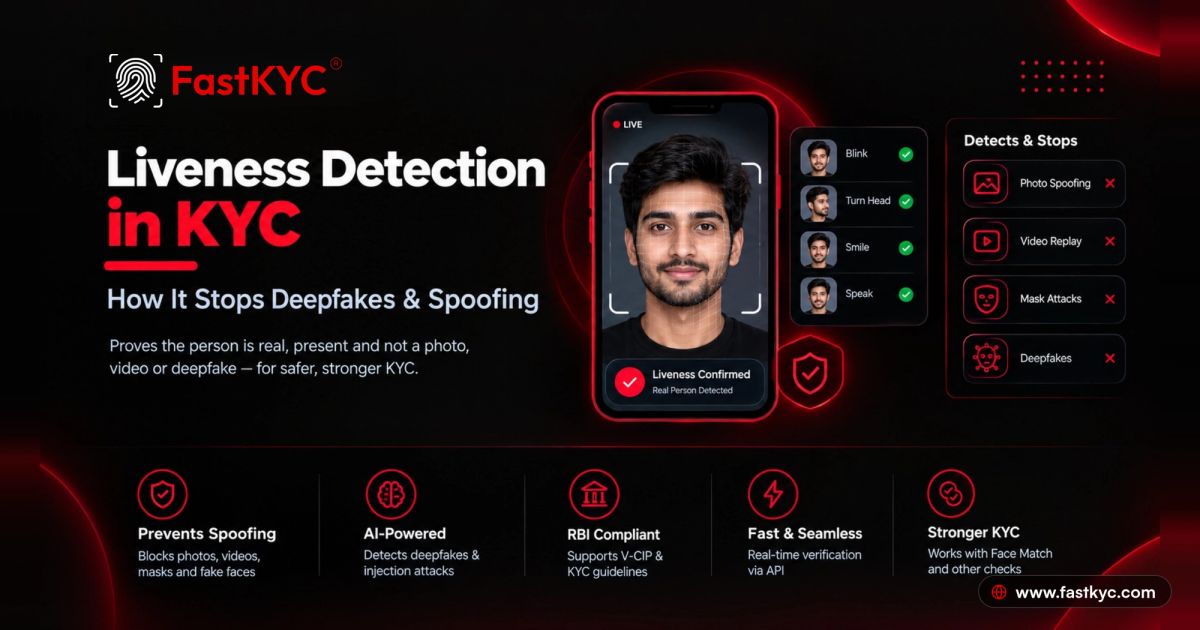
Liveness detection is a technology that verifies whether a facial image or video comes from a live human being rather than a spoof (printed photo, screen replay, mask or deepfake).

It answers a simple but important question:
Is this a real person present right now?

How Liveness Detection Works

There are two main approaches:

1. Active Liveness
The user is asked to perform specific actions such as blinking, turning their head, smiling or speaking a random phrase. The system checks whether the actions are performed correctly in real time.

2. Passive Liveness
The system analyses a single image or short video without asking the user to do anything. It looks for natural signs of life such as skin texture, micro-movements, lighting consistency and depth.

Most modern KYC solutions use a combination of both, along with AI models trained to detect deepfakes and injection attacks.

Liveness Detection vs Face Match

Face Match alone can be fooled by holding up a photo or using a deepfake. Liveness detection alone does not confirm the person matches the ID. Both are needed for strong biometric verification.

Why Liveness Detection Matters

  • Prevents photo and video spoofing
  • Helps detect deepfakes and synthetic faces
  • Required in RBI’s Video KYC (V-CIP) framework
  • Strengthens remote onboarding security
  • Reduces identity fraud in lending and account opening

RBI’s KYC Master Directions require face liveness / spoof detection with a high degree of accuracy as part of V-CIP, along with face matching technology.

Common Use Cases

  • Digital customer onboarding
  • Video KYC / V-CIP sessions
  • Loan and credit card applications
  • Account recovery and re-KYC
  • High-risk or high-value verifications

How Liveness Fits into a Full KYC Stack

A strong digital onboarding flow usually combines:

  1. Document verification (OCR + authenticity)
  2. Face Match (selfie vs ID photo)
  3. Liveness Detection
  4. Other checks (PAN, Aadhaar, bank account, credit report, etc.)

At FastKYC, Liveness Detection works together with Face Match and other identity APIs to create a more secure verification layer.

  • Liveness Detection
  • Face Match
  • Digital KYC
  • Video KYC
  • Biometric Verification

Frequently Asked Questions (FAQs)

What is liveness detection in KYC?

It is a check that confirms the person being verified is a real, live human present at the time of capture, not a photo, video or deepfake.

Is liveness detection mandatory under RBI guidelines?

Yes. RBI’s KYC Master Directions require face liveness / spoof detection with a high degree of accuracy as part of Video-based Customer Identification Process (V-CIP).

What is the difference between active and passive liveness?

Active liveness asks the user to perform actions (blink, turn head, etc.). Passive liveness analyses the image or video without requiring any action from the user.

Can liveness detection stop deepfakes?

Modern systems are trained to detect many deepfake and injection attacks. However, no system is 100% perfect, which is why it is usually combined with Face Match and other risk signals.

Does the user need to perform specific gestures?

Only in active liveness flows. Passive liveness does not require any special gestures.

How accurate is liveness detection?

Accuracy depends on the technology and how well the model is updated against current attack methods. Regulated use cases expect high resistance to common spoofing techniques.

Can liveness detection work on low-end devices?

Most modern solutions are designed to work on standard smartphones. Very old or low-quality cameras may reduce performance.

Is liveness detection the same as face recognition?

No. Liveness checks whether the person is real and present. Face recognition or Face Match checks whether the person matches a specific identity.

How long does a liveness check take?

Usually a few seconds. Passive checks can be almost instant; active checks take slightly longer because of the required actions.

Can liveness detection be automated through an API?

Yes. Businesses can integrate a Liveness Detection API so the check runs automatically during onboarding or Video KYC flows.

Previous articles

All articles

Ready to integrate?

Talk to our team and we will map the checks your flow actually needs.

  • One API key for every check
  • Verified against official Indian records
  • Built for onboarding at scale
FastKYC

Book a demo

See FastKYC on the checks you run

KYC, KYB, Verification APIs, OCR, SMS, WhatsApp & Custom solutions

Tell us what you need to verify and we will get back to you.

APIs
170+
Verifications
1.2M+
Checks a day
5000+