

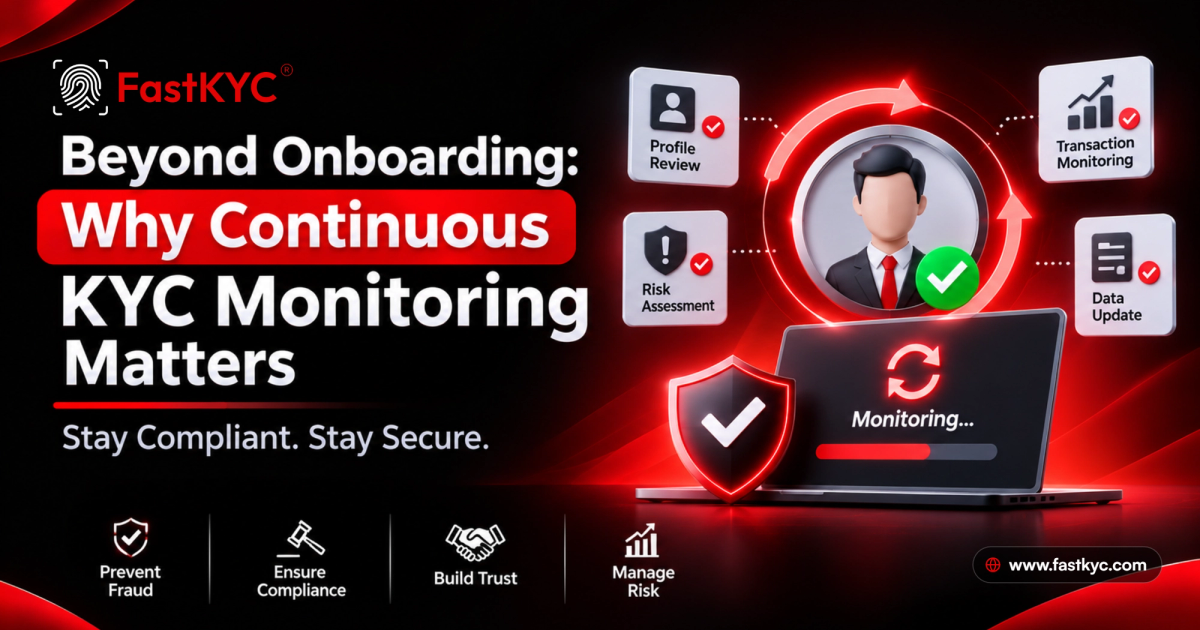
Beyond Onboarding: Why Continuous KYC Monitoring Matters
Discover why continuous KYC monitoring matters, how ongoing customer verification works, and how businesses can identify changing risks.
Vaitheeshwari JSoftware Engineer
On this page 5 sections
Customer verification does not end when an account is opened. As customer details, financial activities and business relationships change over time, organisations need to ensure that the information they hold remains accurate and relevant.
This is where Continuous KYC Monitoring becomes important. It helps businesses identify changes in customer profiles, recognise unusual activities and maintain stronger customer due diligence throughout the business relationship.
What Is Continuous KYC Monitoring?
Continuous KYC Monitoring is the ongoing process of reviewing customer information, risk profiles and relevant activities after the initial verification process.
Traditional KYC focuses on establishing a customer's identity during onboarding. Continuous monitoring takes this a step further by checking whether the customer's information and activities remain consistent with the original profile.
For example, a customer who initially registered as a small business may later expand operations, change business details or begin conducting transactions that differ significantly from their usual pattern. Monitoring helps organisations identify such changes and determine whether further verification is necessary.
Why Is Continuous KYC Monitoring Important?
Customer information is not permanent. Phone numbers, addresses, business ownership, financial activities and risk levels can change over time.
Without regular reviews, businesses may continue relying on outdated information.
Continuous monitoring helps organisations:
- Identify unusual activities: Detect transaction patterns that differ from a customer's expected behaviour.
- Keep customer information updated: Identify changes in identity details, business information and other relevant records.
- Recognise changing risk levels: Reassess customers when new information or activities indicate a potential increase in risk.
- Strengthen fraud prevention: Identify suspicious changes and activities that may require further investigation.
- Support compliance: Maintain ongoing customer due diligence in line with applicable regulatory requirements.
How Does Continuous KYC Monitoring Work?
The process generally involves a combination of customer data reviews, activity monitoring and risk assessment.
1. Customer Profile Review
Businesses periodically review customer information, including identity details, contact information and business records, to identify outdated or inconsistent information.
2. Transaction and Activity Monitoring
Relevant activities are assessed against the customer's known profile. Unusual transaction volumes, complex transactions or unexpected patterns may require additional attention.
3. Risk Assessment
Customer risk profiles are reviewed based on available information and identified changes. Customers presenting higher risks may require closer monitoring and enhanced due diligence.
4. Trigger-Based Verification
Certain events, such as changes in business ownership, expired documents or inconsistencies in customer information, may trigger additional verification.
5. Record Updates and Follow-Up
When changes are identified, businesses can request updated information, conduct additional checks and maintain appropriate records of the review.
Who Benefits from Continuous KYC Monitoring?
Continuous monitoring is valuable across several industries:
- Banks and NBFCs: Monitor customer profiles and financial activities throughout the relationship.
- Fintech companies: Identify changes in customer information and potential account misuse.
- Insurance companies: Keep policyholder information relevant and updated.
- Payment service providers: Identify unusual account activity and potential fraud indicators.
- Businesses and marketplaces: Review merchant, vendor and business partner information as relationships evolve.
How Digital Verification Supports Continuous KYC
Digital verification makes it easier for businesses to review customer information without repeating the entire onboarding process unnecessarily.
Depending on the use case and available data, businesses can use identity document verification, PAN verification, face matching, liveness detection and business verification to validate relevant information when a review is required.
Solutions such as FastKYC help businesses access digital verification capabilities to support customer identity checks and ongoing due diligence workflows.
- Continuous KYC Monitoring
- Ongoing Due Diligence
- Customer Risk Assessment
- KYC Compliance