

FSSAI Verification: A Guide to Verifying Food Business Partners
FSSAI verification helps businesses understand licence types, check food business details and verify suppliers and partners using the FastKYC API.
Harsine K USoftware Engineer
On this page 7 sections
Food businesses operate through a wide network of manufacturers, suppliers, distributors, wholesalers and retailers. When entering into a business partnership, verifying the other party's regulatory credentials is an important part of the onboarding process.
In India, food businesses are regulated by the Food Safety and Standards Authority of India (FSSAI). Businesses involved in food manufacturing, processing, storage, distribution and sale must obtain the applicable FSSAI registration or licence, depending on their activities and eligibility.
What Is FSSAI?
The Food Safety and Standards Authority of India (FSSAI) is a statutory authority established under the Food Safety and Standards Act, 2006. It operates under the Ministry of Health and Family Welfare, Government of India.
FSSAI is responsible for regulating and supervising food safety across India. Its key responsibilities include:
- Establishing food safety standards and guidelines.
- Regulating food manufacturing, processing, storage, distribution and sale.
- Granting licences and registrations to eligible food business operators.
- Monitoring food safety and compliance with applicable regulations.
- Creating awareness about food safety among consumers and businesses.
What Is an FSSAI Licence?
An FSSAI licence or registration is an authorisation required by eligible food business operators to carry out their food-related activities under the applicable regulations.
Businesses involved in activities such as manufacturing, processing, packaging, storage, transportation, distribution and sale of food may need an FSSAI registration or licence, depending on their business category and eligibility.
An FSSAI licence number is a unique 14-digit identifier associated with a registered food business. It can be used to retrieve and verify the available licence information.
Types of FSSAI Registration and Licences
FSSAI licensing and registration are broadly classified into three categories.
1. Basic Registration
Basic registration is generally applicable to petty food business operators with an annual turnover of up to ₹12 lakh, subject to applicable eligibility criteria.
Examples include:
- Small food retailers.
- Petty food manufacturers.
- Hawkers and temporary food stall operators.
- Small-scale food businesses.
2. State Licence
This category covers eligible food businesses such as manufacturers, processors, distributors, wholesalers and storage operators that require authorisation from the respective State Licensing Authority.
Examples include certain:
- Food manufacturers.
- Distributors and wholesalers.
- Storage facilities.
- Food retailers and other eligible food businesses.
3. Central Licence
This category covers food businesses such as importers, exporters, e-commerce operators and businesses operating at specified airports and seaports that require authorisation from the Central Licensing Authority.
This includes certain:
- Large-scale food businesses.
- Food importers.
- Businesses operating across multiple states.
- Food businesses operating in specified locations such as airports and seaports.
The applicable category depends on factors such as the nature of business activity, turnover, production capacity and operational scale. Businesses should refer to the latest FSSAI eligibility criteria to determine the correct category.
What Does the 14-Digit FSSAI Number Represent?
An FSSAI licence or registration number consists of 14 digits. Each part represents specific information associated with the food business.
An FSSAI number follows a structured format:
- 1st digit (Licence or Registration Type):
1represents a licence, while2represents a registration. - 2nd–3rd digits (State or Authority Code): Identifies the State, Union Territory or applicable licensing authority under the relevant numbering format.
- 4th–5th digits (Year Code): Represents the year associated with the original numbering format.
- 6th–8th digits (Authority Code): Identifies the Designated Officer or Registering Authority.
999is used for certain licences initially issued by Central Licensing Authorities. - 9th–14th digits (Serial Number): Represents the unique number assigned to the food business.
Note: FSSAI has revised its numbering and licensing policies over time. Existing licence numbers may retain their original codes even after migration between State and Central licensing authorities. Therefore, the number format alone cannot confirm the current licence type or validity. Always verify the complete details through the official FoSCoS portal.
How to Check FSSAI Licence Details Online?
Businesses can check FSSAI licence or registration details through the official Food Safety Compliance System (FoSCoS) portal.
Follow these steps:
- Visit the FoSCoS official portal.
- Locate the FBO Search option on the homepage.
- Select the appropriate search option.
- Enter the FSSAI licence or registration number and other required details.
- Complete the CAPTCHA and submit the search.
- Review the available food business details.
The portal provides a public facility to verify the available details of an FSSAI licence or registration.
FSSAI Verification API by FastKYC
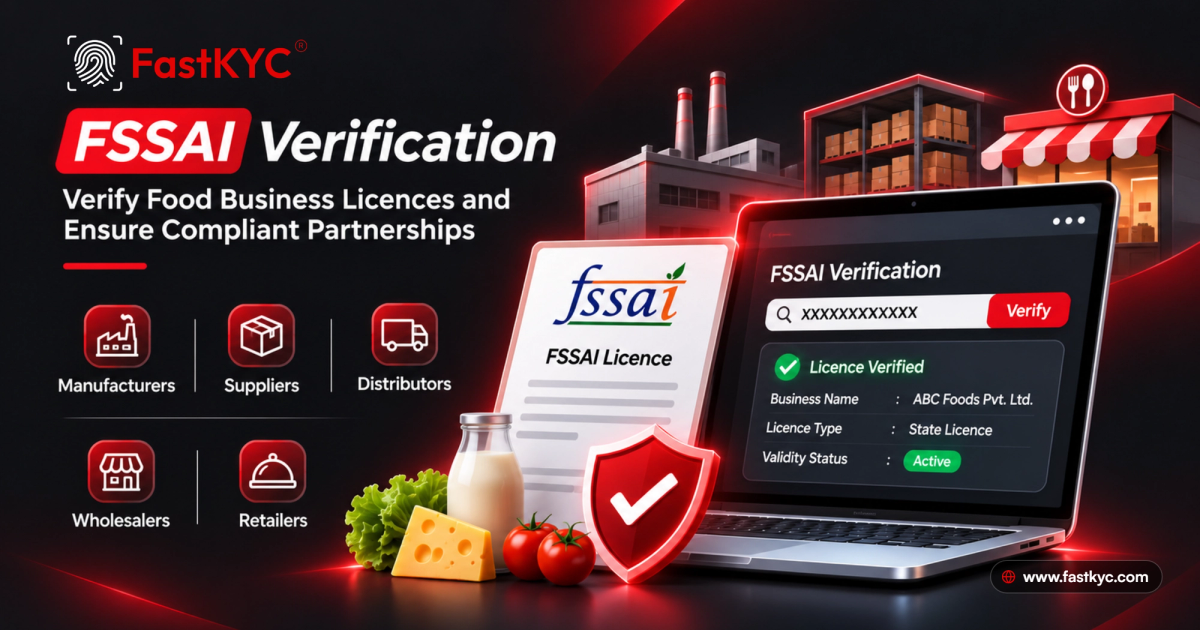
FastKYC provides an FSSAI Verification API that allows businesses to retrieve food business details using an FSSAI licence number.
Businesses can integrate this API into their existing vendor onboarding, supplier verification and partner management systems.
Input Required
The API requires only one input:
license_number: The FSSAI licence or registration number to be verified.
Details Returned
The API provides the following information:
company_name: Registered food business name.address: Registered business address.license_number: FSSAI licence number.license_type: Licence category.validity_status: Licence validity status.
Business Use Cases of FSSAI Verification
1. Supplier and Distributor Onboarding
Food manufacturers and distributors can verify the licence details of prospective suppliers before adding them to their business network.
2. Food Marketplace Onboarding
B2B food marketplaces and platforms can integrate FSSAI verification into their merchant registration workflows.
3. Restaurant and Franchise Partnerships
Restaurant chains and franchise operators can check the licence details of prospective food business partners before establishing partnerships.
4. Food Manufacturing Partnerships
Businesses working with third-party manufacturers can include FSSAI licence verification in their vendor due diligence process.
5. Procurement and Vendor Management
Procurement teams can use automated verification to retrieve licence details while registering and reviewing vendors.
- FSSAI Verification
- Food Safety
- Vendor Onboarding