

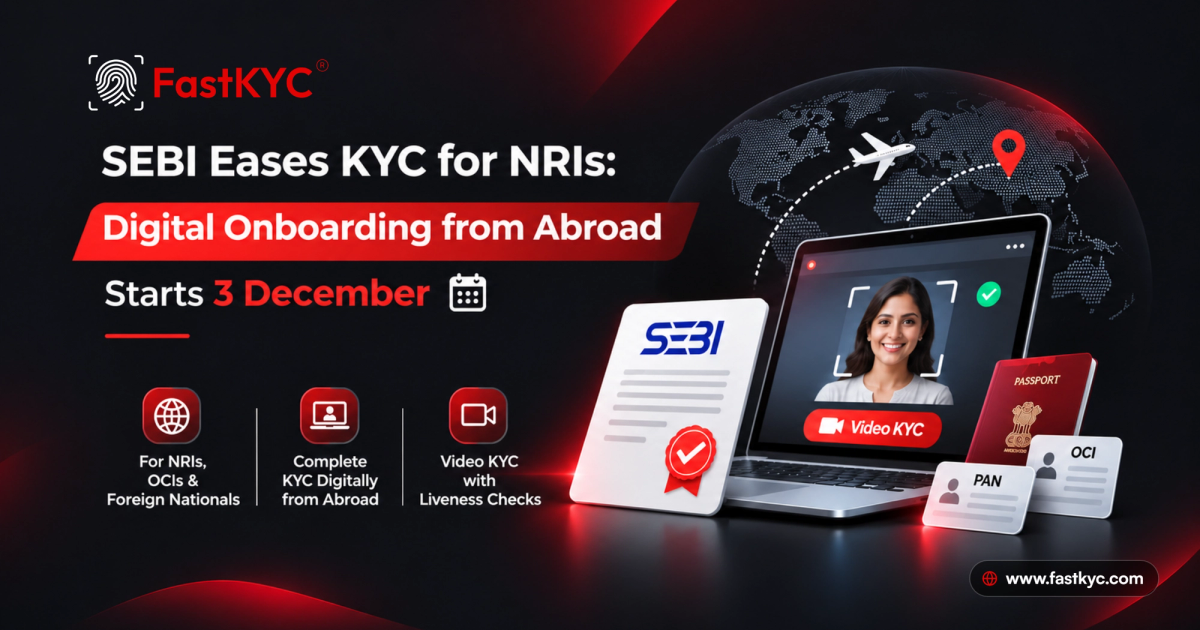
SEBI Eases KYC for NRIs: Digital Onboarding from Abroad Starts 3 December
SEBI has eased digital KYC rules for NRIs, OCIs and foreign nationals in FATF-compliant countries, effective 3 December 2026.
Krithick TSoftware Engineer
On this page 5 sections
On 4 November 2026, SEBI issued a circular that significantly simplifies the KYC process for Non-Resident Indians (NRIs), Overseas Citizens of India (OCIs) and foreign nationals.
The biggest change: eligible overseas investors no longer need to be physically present in India to complete digital KYC. The revised rules come into effect from 3 December 2026.
What Has Changed?
Earlier, SEBI-registered intermediaries had to ensure that the client was physically located in India while doing digital KYC. This created a major friction point for NRIs and foreign investors.
Under the new framework:
- Individual Persons Resident Outside India (PROIs) living in FATF-compliant countries can complete KYC digitally from abroad.
- Physical presence in India is no longer mandatory for digital onboarding.
- Clients from FATF non-compliant countries will continue to follow the existing process.
Who Can Benefit?
The relaxation applies to:
- Non-Resident Indians (NRIs)
- Overseas Citizens of India (OCIs)
- Foreign nationals
Provided they reside in a country that is compliant with Financial Action Task Force (FATF) standards.
Key Features of the New Framework
1. Digital Submission of Documents
Intermediaries can now accept KYC information and supporting documents digitally from eligible overseas clients.
2. Video In-Person Verification (VIPV)
Where physical verification is not possible, Video In-Person Verification is allowed. SEBI has prescribed safeguards such as:
- Live geo-tagging
- Face liveness checks
- End-to-end encryption
- Presence of an authorised official of the intermediary
- Concurrent audit of the process
3. Accepted Documents & Verification Methods
- PAN (to be verified against the Income Tax database)
- Passport
- OCI card (wherever applicable)
- DigiLocker e-documents
- Aadhaar-based authentication (OTP, biometrics or face authentication)
- Attested copies from authorised certifying authorities (notary, embassy, consulate, etc.)
4. Portable KYC Records
KYC records will be portable across intermediaries. Even if some attributes are not fully validated, the record can still be shared with another intermediary.
5. Overseas Address Accepted
For individual PROI clients, the overseas residential address will be treated as the current address.
Why This Matters
This change removes a long-standing barrier for overseas investors who want to open trading or demat accounts in India. It should:
- Speed up onboarding for NRIs and foreign nationals
- Reduce the need for travel or paper-based processes
- Improve the overall investor experience
- Align Indian market access with global digital onboarding standards
What Intermediaries Need to Do
- Update onboarding flows to support remote digital KYC
- Implement compliant Video In-Person Verification with liveness and geo-tagging
- Ensure PAN verification against official databases
- Submit KYC information to the KRA within the prescribed timeline (three working days)
- Maintain proper audit trails and concurrent audit mechanisms
- EBI KYC
- NRI KYC
- Digital Onboarding
- OCI
- Video KYC