

ISIN Verification: Understanding Securities Records
Verify ISIN details using an API. Learn how to retrieve security descriptions, ISIN status, issuer information, and security types for financial workflows.
Vaitheeshwari JSoftware Engineer
On this page 5 sections
Financial institutions and investment platforms rely on accurate securities information to process transactions, manage portfolios, and assess financial assets. However, identifying a security using an identifier alone may not be sufficient. Businesses also need to understand the associated instrument details and verify whether its reference record is active.
An International Securities Identification Number (ISIN) provides a standardised way to identify financial securities across markets. With FastKYC’s ISIN Records API, businesses can retrieve available securities reference details programmatically, reducing manual lookups and simplifying financial data verification.
In this blog, we will explore how ISIN verification works, why it matters, and how businesses can integrate it into their existing workflows.
What Is an ISIN?
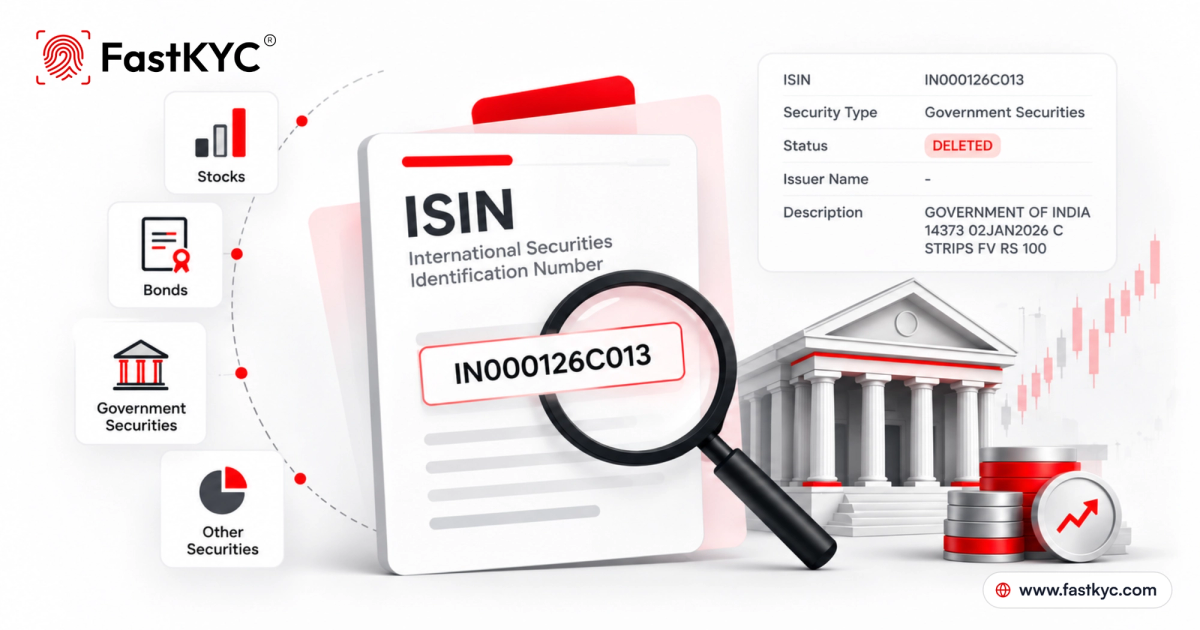
An International Securities Identification Number (ISIN) is a unique 12-character alphanumeric code used to identify securities such as stocks, bonds, government securities, and other financial instruments.
An ISIN consists of three parts:
- Country code: The first two characters identify the country or jurisdiction associated with the numbering system, such as
INfor India. - NSIN: The next nine characters form the National Securities Identifying Number.
- Check digit: The final character is a numeric digit used to validate the identifier through a checksum calculation.
ISINs help banks, lenders, custodians, and investment platforms identify financial instruments consistently across their systems.
Why Is ISIN Verification Important?
Businesses may receive ISINs from customers, internal databases, financial documents, or external systems. Without verification, incorrect identifiers, outdated records, and mismatches between security descriptions can create additional work during financial processing.
For example, a lender assessing securities offered as collateral needs to identify the relevant instrument before conducting further ownership, valuation, and eligibility checks.
Automated ISIN verification helps businesses retrieve reference details quickly and compare them with existing records. It can also help identify securities marked as deleted, allowing the application to flag them for further review.
Common applications include:
- Lending and NBFCs: Identify securities submitted as collateral before performing additional checks.
- Investment platforms: Validate security references during application and transaction processing.
- Portfolio reconciliation: Match ISINs and descriptions against internal records.
- Custody and financial operations: Maintain consistent securities information across systems.
- Compliance and risk management: Incorporate reference-data checks into broader review workflows.
By integrating verification into existing applications, businesses can reduce repetitive manual work and improve consistency in securities data management.
What Information Does the FastKYC ISIN Records API Provide?
FastKYC’s ISIN Records API enables businesses to retrieve available information associated with a submitted ISIN. Depending on the returned record, the response may include:
- isin: The identifier associated with the lookup.
- description: A description of the security, including relevant instrument details.
- isin_status: The record status, such as
ACTIVEorDELETED. - issuer_name: The issuer's name, when available.
- security_type_description: The security category, such as
GOVERNMENT SECURITIES.
These fields help applications identify instruments and compare retrieved information with their internal records.
It is important to distinguish API success from security status. A successful response indicates that the request was processed, but the returned isin_status must be evaluated separately. A DELETED record should be reviewed before it is used in a business workflow. Similarly, an empty issuer_name does not necessarily indicate a failed request.
ISIN verification provides reference information; it does not independently establish ownership, market value, tradability, or eligibility for a financial transaction.
How to Check an Online ISIN Verification
For occasional lookups, users can search for securities through the official NSDL Master Search facility.
Enter the ISIN or the relevant company or security name, submit the search, and review the available results. Depending on the record, the results may include the ISIN description, issuer name, security type, and status.
This method is useful for individual checks and manual cross-verification. However, businesses processing large volumes of securities data may benefit from API integration, which allows reference checks to run directly within their applications without requiring repeated manual searches.
Business Use Cases of ISIN Verification
ISIN verification is useful for businesses that work directly with securities reference data. By retrieving available security details and status information, the FastKYC ISIN Records API can support the following workflows.
1. Lending and Collateral Management
Banks and NBFCs can use ISIN verification to identify securities offered as collateral. The returned description and security type help lenders compare the submitted identifier with the expected instrument before conducting separate ownership, valuation, and collateral eligibility checks.
2. Investment and Wealth Management Platforms
Investment platforms can use ISIN lookups to match security identifiers with available reference details when onboarding instruments or processing investment-related requests. This helps reduce mismatches between submitted identifiers and internal security records.
3. Securities Portfolio Reconciliation
Asset managers and financial operations teams can compare ISINs and security descriptions against their internal portfolio records. This helps identify discrepancies in instrument identification during reconciliation.
4. Security Master Data Management
Financial institutions and securities operations teams can use the API to validate security identifiers and retrieve available descriptions, issuer names, and security classifications when creating or updating internal security master records.
These use cases focus on securities identification and reference-data validation. ISIN verification alone does not confirm ownership, market value, tradability, or investment eligibility, these require separate checks.
- ISIN Verification
- Security Status
- Securities Identification