

RBI’s New Money Transfer Rules: KYC & Authentication Requirements
RBI issued New KYC registration, verified mobile number and Additional Factor of Authentication are now mandatory for cash-based transfers.
Krithick TSoftware Engineer
On this page 7 sections
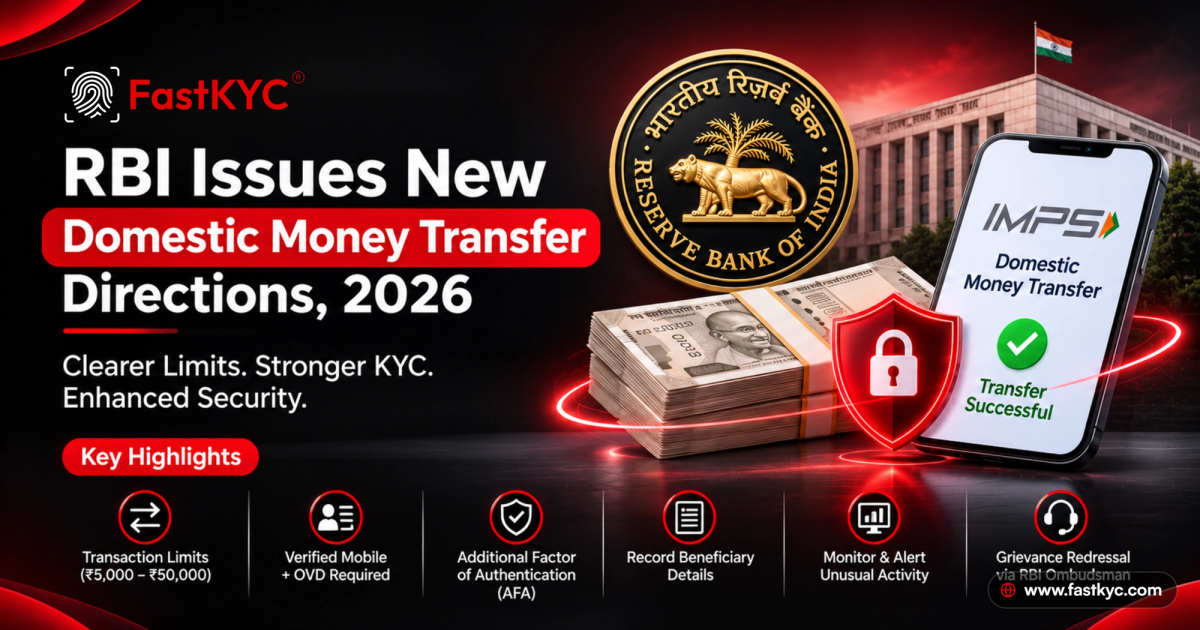
On 11 November 2026, the Reserve Bank of India issued the Reserve Bank of India (Domestic Money Transfer) Directions, 2026. These directions consolidate earlier circulars on domestic money transfers and came into effect immediately.
The new framework clarifies transaction limits and tightens customer verification, especially for cash-based transfers through business correspondents (BCs), ATMs and other channels.
What the New Directions Cover
The directions apply to scheduled commercial banks (including RRBs and co-operative banks) and authorised payment system operators.
They cover two main types of cash-based services:
- Cash Pay-in – Customer deposits cash to send money to a beneficiary’s bank account
- Cash Pay-out – Money is sent so that a beneficiary without a bank account can collect cash
KYC and Registration Requirements
For cash-based transfers through BCs, ATMs and similar channels, the remitter must be registered using:
- A verified mobile number
- A self-certified Officially Valid Document (OVD) as per the RBI KYC Directions, 2025
This registration step is mandatory. Without a verified mobile number and valid OVD, the customer cannot use these channels for cash transfers.
Additional Factor of Authentication (AFA)
Every transaction by the remitter must be validated through an Additional Factor of Authentication (AFA).
This means a second layer of verification is required before the transfer is processed. It adds an important security control against unauthorised or fraudulent transactions.
Other Important Requirements
- The remitting bank must record and maintain the name and address of the beneficiary (especially for cash pay-out).
- Remitter details must be included in the IMPS/NEFT message, along with an identifier that marks the transaction as a cash-based remittance.
- Banks are expected to monitor for unusual activity, run velocity checks, and alert authorities when suspicious patterns appear.
- Grievances fall under the Reserve Bank – Integrated Ombudsman Scheme.
Why This Matters
These directions make the rules clearer and more consistent across channels. At the same time, they raise the bar on identity verification and authentication for cash transfers.
For banks, BCs and payment operators, the focus areas are:
- Proper remitter registration with verified mobile + OVD
- Reliable AFA implementation on every transaction
- Clean record-keeping of beneficiary details
- Strong monitoring of cash-based flows
Practical Takeaways for Compliance Teams
- Update agent manuals and BC systems to capture verified mobile number and self-certified OVD
- Ensure AFA is enforced on every cash-based remittance
- Review how remitter and beneficiary details are stored and passed in payment messages
- Align monitoring rules with the new velocity and alert expectations
Strengthen Verification for Money Transfer Flows
Accurate identity checks and strong authentication are now central to domestic money transfer compliance.
- PAN, Aadhaar and document verification
- Mobile number validation support
- Built for regulated onboarding and transaction flows
- RBI
- Domestic Money
- Transfer
- KYC
- AFA
- Cash Transfer