

Re-KYC in India: When and How to Update Customer Details
Learn when KYC updates are required, which documents you need, and how to complete the process online.
Vaitheeshwari JSoftware Engineer
On this page 7 sections
Opening a bank account or using a financial service involves submitting identity and address documents for Know Your Customer (KYC) verification. However, KYC is not a one-time process. As customer information changes over time, financial institutions need to ensure that their records remain accurate and up to date.
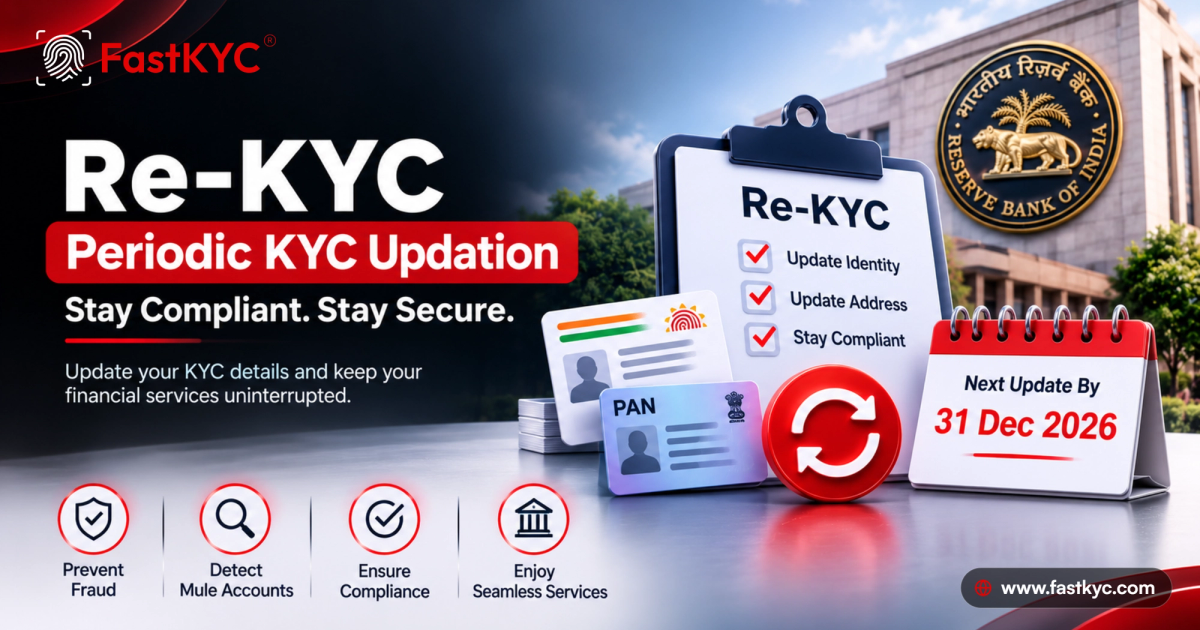
This process is known as Re-KYC (Periodic KYC Updation). It allows banks and other regulated financial institutions to reconfirm customer information, update identification details, and meet applicable regulatory requirements.
In India, the Reserve Bank of India (RBI) has introduced guidelines to simplify periodic KYC updation, including digital self-declarations and different verification methods. Understanding when Re-KYC is required and how to complete it can help customers avoid unnecessary delays in their banking services.
In this blog, we will explore the Re-KYC process in India, the documents required, applicable RBI guidelines, and how customers can update their KYC details.
Why Is Re-KYC Required?
Maintaining updated customer information is important for both customers and financial institutions. Outdated records can create difficulties during account servicing, customer verification, and regulatory reviews.
Re-KYC helps address these challenges in several ways:
- Accurate customer information: Keeps identity and address details updated in financial records.
- Regulatory compliance: Helps regulated entities meet applicable KYC and customer due diligence requirements.
- Fraud prevention: Helps institutions identify inconsistencies in customer information and investigate unusual changes.
- Customer risk assessment: Supports ongoing evaluation of customer profiles and risk categories.
- Smooth banking services: Reduces issues caused by outdated or incomplete KYC information.
Re-KYC is therefore an important part of maintaining an ongoing relationship between customers and financial institutions.
When Is Re-KYC Required in India?
The RBI follows a risk-based approach for periodic KYC updation. For banks covered by the RBI's Commercial Banks KYC Directions, the minimum frequency depends on the customer's risk classification.
High-risk customers must undergo periodic KYC updation at least once every two years, medium-risk customers once every eight years, and low-risk customers once every ten years. These periods are calculated from the date of account opening or the last KYC updation, as applicable.
Apart from these periodic requirements, customers may also need to update their KYC information when their personal or identification details change.
For example:
- A customer relocates and has a new residential address.
- A customer updates their identification documents.
- A minor account holder becomes an adult.
- A business experiences changes in its ownership or beneficial ownership information.
Under applicable RBI requirements, customers should submit updated documents within 30 days of a change or update to the documents submitted during the establishment of the banking relationship.
Banks also have requirements to send advance intimations and reminders to customers approaching their periodic KYC due dates.
The actual process and additional requirements may vary depending on the type of regulated institution and its approved KYC policy.
What Documents Are Required for Re-KYC?
The documents required for Re-KYC depend on whether the customer is reconfirming existing information or requesting changes to their records.
1. When There Is No Change in Information
If the customer's existing KYC details remain unchanged, a self-declaration confirming that there are no changes may be sufficient.
Customers can generally submit this declaration through their registered email address, mobile number, internet banking, mobile banking, ATM, or other channels supported by their bank.
2. When Only the Address Has Changed
If a customer has moved to a new residential address, they can submit a self-declaration containing the updated address.
The bank may request supporting address documents according to its approved KYC policy. The declared address must be verified through positive confirmation within two months using appropriate methods.
3. When Other KYC Details Have Changed
If the customer's identity or other relevant information has changed, updated supporting documents may be required.
Commonly accepted Officially Valid Documents (OVDs) under applicable KYC requirements include:
- Passport
- Driving Licence
- Proof of possession of Aadhaar number
- Voter's Identity Card
- NREGA job card
- Letter issued by the National Population Register
PAN or Form 60 may also be required, depending on the applicable requirements.
Customers should check with their respective financial institution to confirm the exact documents needed for their particular update.
How to Complete Re-KYC in India
Customers can complete Re-KYC through different methods depending on the bank's available facilities and the type of information being updated.
1. Online Banking or Mobile Banking
Customers can log in to their bank's internet banking portal or mobile application and follow the Re-KYC instructions. If there are no changes in their existing information, they may be able to submit a self-declaration digitally.
2. Registered Email or Mobile Number
For cases involving no change in KYC information or a change only in address, customers can submit the required self-declaration through their registered email address or mobile number, subject to the bank's verification process.
3. Video-Based Customer Identification
Banks may use Video-based Customer Identification Process (V-CIP) for eligible customers to complete identity verification remotely. This allows customers to complete the required verification without visiting a physical branch.
4. Bank Branch Visit
Customers can visit an eligible bank branch and submit the required declaration or updated documents. Banks may facilitate Re-KYC at branches other than the branch where the account was originally opened, subject to applicable requirements.
5. Business Correspondents (BCs)
Authorised Business Correspondents can facilitate certain KYC updates, including self-declarations and supporting documents, through approved processes. This provides an additional option for customers who may have limited access to banking facilities.
Business Use Cases of Re-KYC
Re-KYC is relevant to businesses that maintain ongoing customer relationships and need to keep their KYC records updated.
1. Banking and Account Management
Banks can incorporate periodic KYC updation into account management processes to maintain accurate customer profiles and ensure that identification records meet applicable requirements.
2. NBFCs and Digital Lending
NBFCs can use customer verification workflows to update borrower information and support ongoing due diligence throughout the loan lifecycle.
3. Insurance Companies
Insurance providers can use KYC updation processes to maintain accurate policyholder information and support customer verification during policy servicing and other applicable activities.
4. Fintech and Digital Financial Platforms
Digital financial platforms can integrate identity and document verification into their customer management systems to facilitate information updates and reduce manual verification efforts.
5. Customer Due Diligence and Risk Management
Regulated financial institutions can use updated customer information as part of ongoing due diligence, customer risk reviews, and enhanced verification where necessary.
How Digital Verification Simplifies Re-KYC
Traditional KYC updation can involve collecting documents, checking customer information, and manually updating records. Managing these activities across a large customer base can increase operational effort.
Digital verification helps simplify these workflows by allowing businesses to retrieve and validate available customer information through integrated verification systems.
For example, identity verification can help validate supported identity details, while document verification and OCR can assist in extracting information from uploaded documents.
These capabilities can support customer verification workflows, but they do not replace the regulated entity's responsibility to obtain necessary customer consent, follow applicable RBI requirements, and complete the required due diligence.
Simplify Customer Verification with FastKYC
Maintaining accurate customer information is essential for financial institutions to support ongoing customer relationships and regulatory compliance.
FastKYC provides identity verification and document verification solutions that businesses can integrate into their customer verification workflows. These capabilities can help banks, NBFCs, fintech companies, and other organisations retrieve and validate customer information more efficiently.
By combining digital verification with appropriate customer consent and record management, businesses can simplify their KYC updation workflows and improve operational efficiency.
- Re-KYC
- Periodic KYC Update
- Customer Due Diligence
- Identity Verification